


周二,2018达沃斯论坛上,印度总理莫迪发表演讲,中国和印度加入批评美国贸易保护政策的行列。
China and India have joined ranks in criticizing US protectionism with Indian Prime Minister Narendra Modi making a pitch for globalization in his inaugural speech at the World Economic Forum annual meeting in Davos on Tuesday. Modi echoed the message sent out by Chinese president Xi Jinping in his keynote address at the same event last year.
The common position by two of the largest emerging economies comes at a time when the US, a former champion of globalization, is becoming increasingly isolated over the protectionist policies enshrined under President Donald Trump’s “America First” agenda. Trump will make his first address at the Davos summit on Friday.
China was quick to hail the Indian leader’s speech at the plenary session of the Davos summit, where Modi mounted a strong defense of globalization while describing protectionism as being “as dangerous as terrorism”.
Asserting that both countries share common ideas and interests in opposing trade protectionism, the Chinese Foreign Ministry said that Beijing is willing to work with India and other countries towards maintaining globalization.
"President Xi Jinping's keynote speech with the theme of "jointly shoulder responsibility of our times and promote global growth" at the World Economic Forum in Davos a year ago still remains fresh in our memories. He made a Chinese voice on promoting economic globalization towards a more open, inclusive, mutually beneficial, balanced and win-win direction. He advocated developing an open world economy and created a profound international influence," China’s Foreign Ministry Spokesperson Hua Chunying said at a press briefing on Wednesday.
She added that Modi's speech “reflected the contemporary trend of economic globalization conforming to the interests of all countries, especially developing countries. China hopes to work with every country, including India, to actively adapt to and guide globalization, making it a force that promotes world economic growth and improves people's well-being."
On Tuesday, Modi took a cue from Xi’s speech last year and stressed the ills of isolation as a backlash against globalization.
“Forces of protectionism are raising their heads against globalization. Their intention is not only to avoid globalization themselves, but they also want to reverse its natural flow,” Modi said, adding that “the negative impact of this kind of mindset cannot be considered less dangerous than climate change or terrorism.”
Many saw Modi’s speech as a veiled criticism of Trump’s protectionist “America First” strategy.
Urging governments not to turn towards isolationism, Modi quoted India’s leader of independence Mahatma Gandhi: “I don’t want the windows of my house to be closed from all directions. I want the winds of cultures of all countries to enter my house with aplomb and go out also.”
Modi’s speech in many ways resonated with last year’s words by Xi who stressed that blaming economic globalization for the world's problems is inconsistent with reality and unhelpful to solving the problems in hand.
The Chinese president had pointed out that "pursuing protectionism is like locking oneself in a dark room," adding, "wind and rain may be kept outside, but so is light and air. No one will emerge as a winner in a trade war."
China and India have routinely criticized Trump’s protectionist measures and anti-immigration policies as the two Asian neighbors have sought common ground to push for globalization and better trade ties.
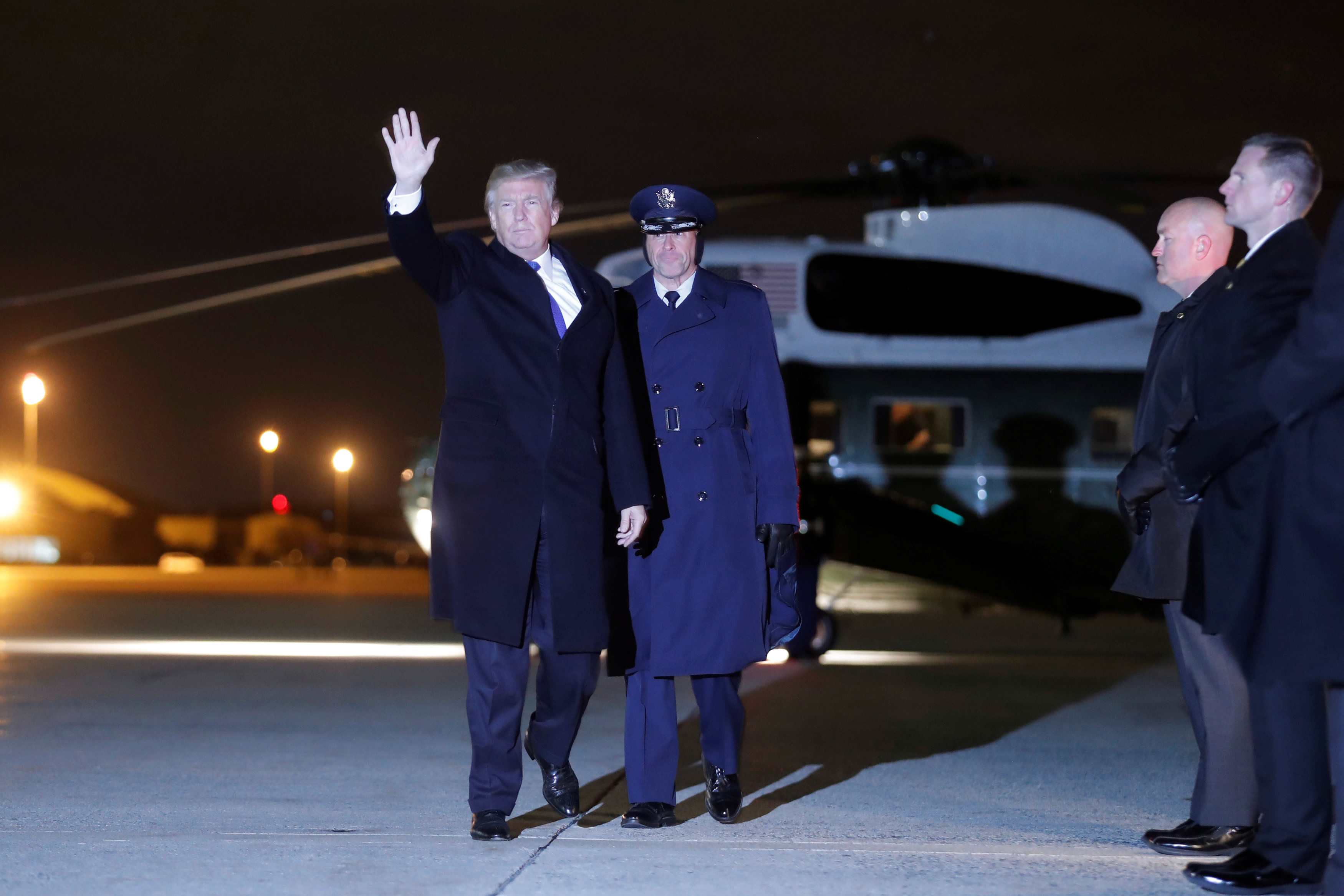
US President Donald Trump waves as he boards Air Force One for travel to Switzerland to attend the World Economic Forum (WEF) annual meeting in Davos from Joint base Andrews, Maryland, US, on January 24, 2017. /Reuters Photo
On Friday, Trump is expected to announce at Davos that “America is open for business” and that he himself “wants the world to invest in America and create jobs for hard-working Americans”, according to White House sources quoted by the media.
Trump’s policies are seen as a hindrance for emerging and developing economies.
Beijing agreed that the common economic and development interests will push India and China to improve bilateral ties, which have been strained in recent months over border issues.
"India is a big neighbor of China. As two largest developing countries and neighbors, of course we hope the two countries will maintain a healthy and stable development of bilateral relations, which is in the common interests of the two countries," Hua said.
"China hopes for and looks forward to working together with India to continuously enhance communication and contact, deepen understanding and mutual trust, and properly handle disputes, so as to ensure a healthy and stable development of bilateral relations. This is what I believe people of the two countries hope to see," she added.