

中国将缩短城乡教育差距
Information office of China's state Council is holding a press conference in Beijing. Vice Minister of Education, Liu Limin, and Vice Minister of science and Technology, Zhang Laiwu, are expected to outline ways of improving the basic conditions at many of China's rural schools, at the compulsory education stage. They'll also talk about innovations in agricultural science and technology.
The Chinese government has spent nearly 6.6 billion US dollars on renovating rural schoolhouses in less developed regions over the past three years. Students' living conditions have improved since 2010 when the Ministry of Education and the Ministry of Finance launched a program of renovating buildings of primary and junior schools in rural areas. The program, covering less developed central and western China as well as Liaoning, Shandong and Fujian provinces in east China, is aimed at narrowing the education gap between rural and urban areas and balancing the distribution of education resources better.
Nearly 69,000 schoolhouse renovation projects started from 2010 to 2013, of which more than 51,000 have been completed. The dormitory area for each primary school pupil reached 3.1 square meters and 4.2 square meters for each junior school students, an increase of 24 percent and 40 percent from that of 2009 respectively. Nearly 700 counties in poor areas built school restaurants, facilitating the government’s efforts to improve students’ nutrition.
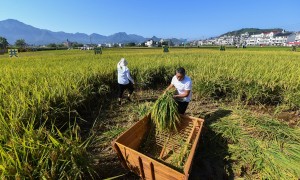
China accounts for a fifth of the world's population, but with less than 9 percent of its land arable, China's leaders have aimed to boost agriculture technology to ensure food supply. In July, president Xi Jinping said during a tour of rural areas in central China's Hubei Province that the country's food security issue could only be solved by the country itself, indicating that the country should not rely on imports for its food supply. Analysts say recent moves, such as the initiatives by the Chinese Academy of Sciences in the Bohai Bay Rim area, which includes Musanba Village, reflect China's determination to tackle the problem by promoting agriculture innovation.
According to statistics released by the Chinese Academy of Sciences, China has more than 40 million mu of medium- and low-yield fields, and 10 million mu of saline soils in four provincial-level divisions, including Hebei, Shandong, Liaoning, and Tianjin in the Bohai Bay rim area. If technology can overcome problems such as barren soil and the lack of freshwater resources, the potential of these lands could be huge. Researchers estimate that by 2020, the Bohai Bay rim will have the potential to increase crop production by 5 billion kilograms per year.