

Spacecraft, set for 2016 launch, will find data on electromagnetic signals
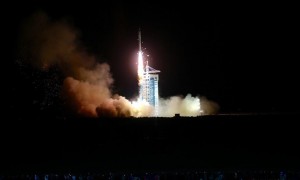
China's first test satellite for detecting electromagnetic anomalies from space will launch in 2016 in a move that is aimed at improving the country's earthquake monitoring network and moving its seismological science forward.
Yuan Shigeng, project manager for the satellite, said the polar-orbiting device will carry eight payloads, including a search-oil magnetometer, electric field detector, energetic particle sensors designed by China and Italy, and a Langmiur probe and plasma analyzer.
The satellite will collect and transmit data on electromagnetic signals in the Earth's ionosphere at altitudes of 507 km.
During its mission life of five years, the satellite will collect and supply data for research on earthquake monitoring, earth science and space science.
The China Earthquake Administration will be the main client for the satellite.
Shen Xuhui, a professor at the institute of earthquake science at the CEA, said the satellite's detection capabilities include large-scale, highly dynamic, multi-parameter and all-weather features, which will be important for the current ground monitoring network.
Scientists hope any major breakthrough in the research will help them understand earthquakes better so lives can be saved.
"Through these data, we try to understand what natural warnings, such as changes in electromagnetic signals, are indicating prior to earthquakes," Shen said.
China experienced 43 earthquakes of above magnitude-5.0 last year, twice the annual number over the past three decades, that claimed thousands of lives, according to statistics released by the Ministry of Civil Affairs.
Earthquakes are a sudden release of energy caused by the sliding of the Earth's crust along fault lines, and changes to fluorescent, infrared and magnetic signals can be detected in advance.
China's latest project started in 2003 and its test satellite is now in the preliminary design stage. Shen has been involved in the project from the start.
"Among the many signals that nature may provide before earthquakes occur, we've chosen magnetic ones because we are technically and economically ready," Shen said.
Roberto Battiston, a professor at the university of Trento in Italy, said that studying magnetic and electric fields is a wise choice for earthquake science.
Over the last 30 years, various studies have suggested a link between seismic activity and the precipitation of energetic electrons trapped in the Van Allen Belts, Battiston said.
Studies suggest that strong seismic activity often causes electromagnetic anomalies in the Earth's atmosphere, ionosphere and magnetosphere, aiding the monitoring and prediction of earthquakes.
Battiston said the collaboration between Italy and China is "extremely effective" and he looks forward to the first data from China's electromagnetic satellite.
Seismologists in China have been working with other countries including France, Italy, Russia and Ukraine that have their own advantages in seismo-electromagnetic research.
Battiston said earthquakes are a global phenomenon, and the development of techniques to mitigate their damage will greatly benefit from international collaboration.
With the successful launch of the satellite, China will join a select group of nations that have their own earthquake monitoring satellites, which could broaden international collaboration in the field.
Dimitar Ouzounov, a professor of earth sciences at Chapman University in California, also spoke highly of China's project, saying it "provides an excellent opportunity to advance the well-integrated space-ground system in earthquake monitoring in the near future in China".
China's satellite mission could become the focal point for future international cooperation among many scientists in space physics, electromagnetic observation and satellite methodologies for earthquake monitoring and warnings, the professor said.